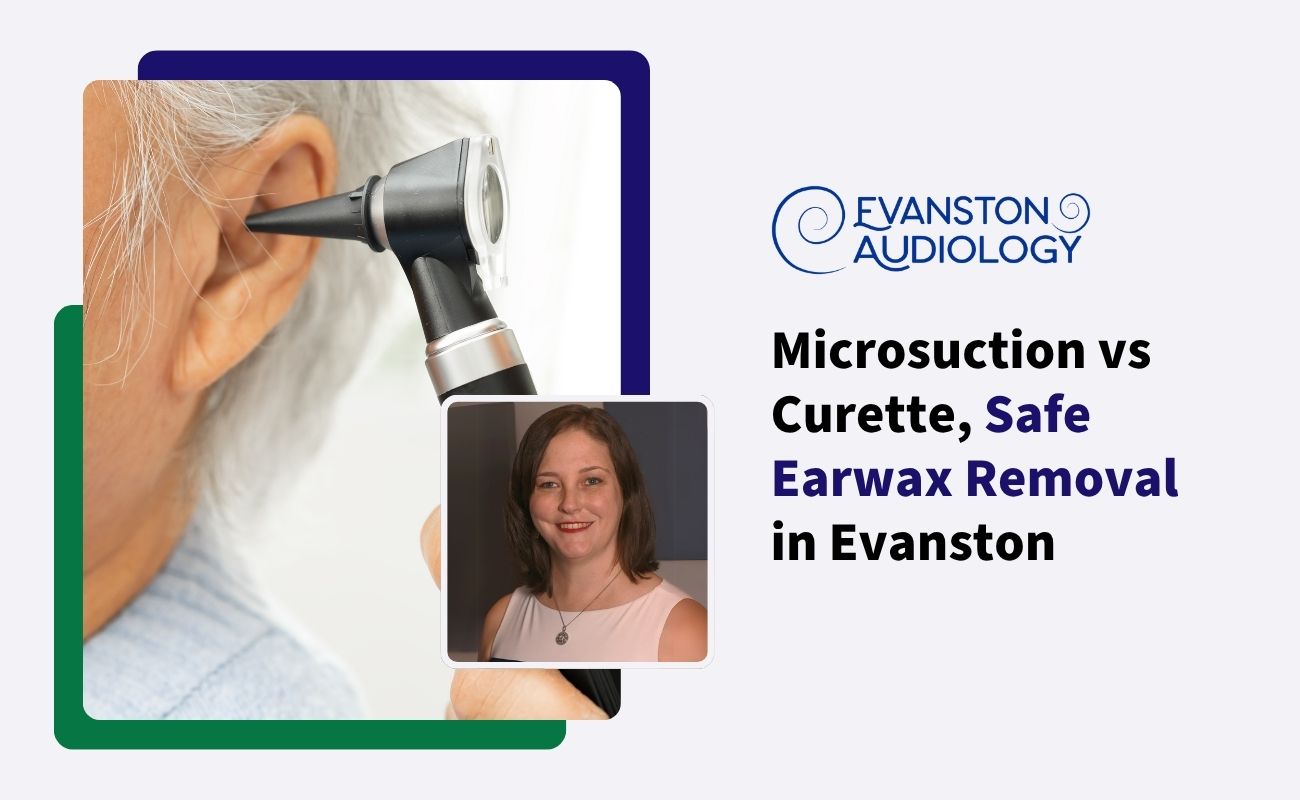
Microsuction vs Curette, Safe Earwax Removal in Evanston

Late summer brings a predictable wave of clogged ears into our office. Weeks of swimming, earbuds, and sweaty runs push wax deeper into the canal than usual, and by the time September rolls around, a lot of patients are asking the same question: why does everything suddenly sound muffled? Often, the answer is simple. It's earwax.
We get calls every year from people convinced their hearing aids have stopped working, only to find out the real problem was buildup blocking the microphone or the receiver. If that sounds familiar, you're not alone, and it's an easy fix once we take a look.
Microsuction, Curette, and Why We Skip Irrigation
There are a few different ways to remove earwax, and not all of them carry the same level of risk.
Microsuction uses a microscope and a gentle medical suction device to lift wax out of the canal under direct visualization. We can see exactly what we're doing the entire time, which makes it a good option for hard or impacted wax and for ears that are sensitive or prone to irritation.
Manual removal with a curette is a small, curved instrument used to scoop out softer wax under magnification and a specialized light. For milder buildup, this approach works well and tends to be quick.
Ear irrigation, on the other hand, is not something we offer at Evanston Audiology. Irrigation flushes water into the canal under pressure, and while it's a common method at some clinics, some primary care offices, and immediate care centers it comes with real downsides. It can push wax further in rather than clearing it. When wax is present it's impossible to know if there is already an eardrum perforation, and it isn't ideal for patients with a history of ear infections, tubes, prior surgery, or diabetes. Is ear irrigation safe? For some people, in the right hands, it can be, especially those on blood thinners. But microsuction and curette removal give us more control and more precision, which is why they're the only methods we use.
If You Wear Hearing Aids, Pay Attention to This
Hearing aid users are at higher risk for wax buildup, and it's not because their ears produce more wax. It's because the device itself sits in or near the canal all day, which can interfere with the ear's natural process of clearing wax on its own. Over time, that wax has nowhere to go.
This is where the "my hearing aid stopped working" story comes from more often than people expect. A whistling sound, muffled speech, or a device that seems weaker than it used to be can all trace back to wax sitting on the microphone port or blocking the receiver. Before assuming a hardware problem, it's worth having your ears checked. We see this constantly, and it's genuinely one of the easier issues to resolve.
Regular hearing testing also helps here. If your hearing seems to be changing, a quick evaluation can tell us whether wax is playing a role or whether something else needs attention.
What Not to Do at Home
A lot of home remedies feel harmless, but several of the most common ones can actually make things worse.
- Cotton swabs push wax deeper into the canal instead of removing it, and they can scratch the delicate skin lining the ear or damage the eardrum if inserted too far.
- Ear candling has no proven benefit and carries a real risk of burns, wax dripping into the canal, or candle residue getting stuck where it doesn't belong.
- At-home removal kits purchased online vary widely in quality, and using the wrong tool without proper visualization can cause the same problems as cotton swabs, sometimes worse.
If you're dealing with a feeling of fullness, ringing, dizziness, or muffled hearing, skip the home remedies and let a trained professional take a look.
Earwax Removal Cost and What to Expect
We get asked about earwax removal cost fairly often, and it depends on which method is appropriate for your ears and whether you're an existing patient. The appointment itself is straightforward. We start with an otoscope exam to assess how much buildup there is and where it's sitting, then choose microsuction or curette removal based on what we see. Most appointments wrap up in just a few minutes and are generally painless.
Schedule Earwax Removal in Evanston
Kate Dunckley and our team have spent years combining research training with hands-on clinical care, and earwax removal is one of the more routine, satisfying parts of what we do. Patients often tell us they had no idea sound could be that clear again.
If you're searching for professional ear wax removal near Chicago's north side, or if you've noticed your hearing aids acting up since summer wrapped up, give us a call. We're located at 1811 Benson Ave in Evanston, on the corner of Benson and Clark, and you can reach us at 847-869-9433. You can also contact us directly to schedule, or read more about our earwax removal services before your visit.
Contact us to learn more about our services and hearing aid options.
Office
Visit us at 1811 Benson Ave, Evanston.
Located on the corner of Benson and Clark.
For those traveling on public transportation, we are conveniently located just steps away (600 ft) from the Davis CTA and Pace bus terminal, and Purple Line hub. We are also only 600 ft from the Metra Union Pacific-North (UP-N) Davis stop.
Opening Hours
Holiday Closures
2026: 1 January, 19 January, 25 May, 4 July, 7 September, 26-27 November, 25 December
2027: 1 January